|
|
DOCUMENTS
They Won't Let Sacco and Vanzetti Die
Published at the Harvard Crimson, Massachusetts
Source: https://www.thecrimson.com/article/2025/2/13/sacco-vanzetti-archive/
Nicola Sacco and Bartolomeo Vanzetti have been arrested in time on the third floor of the Community Church of Boston.
They are interred, not in a tomb — their bodies were cremated shortly after their executions — but in an archive, a testament to a radical tradition and the first Red Scare which sought to disrupt it. In the Church, their memory has found a temporary resting place.
The Community Church of Boston, originally, was not bound by a building. In its salad days, it was a roving congregation that filled grand concert halls with eager Boston reformers. These meetings sparked an illustrious and ongoing speaker series, featuring the likes of W.E.B. DuBois, Martin Luther King, Jr., and Angela Davis.
Read more
Sacco and Vanzetti Works by David Rothauser27/10/2022 -  David Rothauser is the Founder of Memory Productions, an independent film/video company dedicated to making films that tell the stories of people who should forever be remembered for their contribution to the world we live in and for their undying love of human kind. David Rothauser is the Founder of Memory Productions, an independent film/video company dedicated to making films that tell the stories of people who should forever be remembered for their contribution to the world we live in and for their undying love of human kind.
David received The Sacco-Vanzetti Memorial Award from the Community Church of Boston in 1999. Read more
Bob D’Attilio and the Sacco and Vanzetti Commemoration Society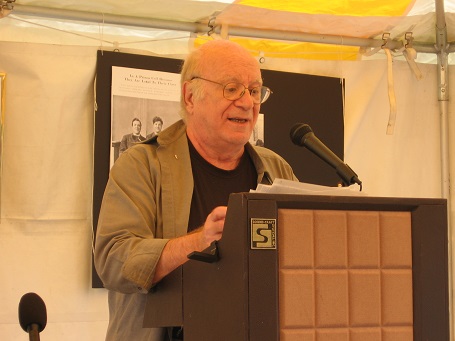 05/12/2020 - Bob D’Attilio’s (*) name was so closely associated with the names of Sacco and Vanzetti and the Italian anarchists of Boston that anyone doing serious research on the subject was almost obligated to get in contact with him. His vast knowledge of the case was only surpassed by his devotion to collecting and preserving everything related to the case and the Italian anarchists to which the two men were so closely connected. This knowledge and devotion made Bob an invaluable resource in exploring every facet of the history surrounding Boston at the time. It was natural that when the Sacco and Vanzetti Commemoration Society was forming, Bob was asked to join. 05/12/2020 - Bob D’Attilio’s (*) name was so closely associated with the names of Sacco and Vanzetti and the Italian anarchists of Boston that anyone doing serious research on the subject was almost obligated to get in contact with him. His vast knowledge of the case was only surpassed by his devotion to collecting and preserving everything related to the case and the Italian anarchists to which the two men were so closely connected. This knowledge and devotion made Bob an invaluable resource in exploring every facet of the history surrounding Boston at the time. It was natural that when the Sacco and Vanzetti Commemoration Society was forming, Bob was asked to join.
Read more
Bob D’Attilio is gone: The American "memory" of the Sacco and Vanzetti case
 26/11/2020 - The news came suddenly and contained the rituality of those compassionate words that leave a lump in your throat and prevent you from going further: Bob D’Attilio is dead. He left suddenly, in silence and solitude, found lifeless in the apartment where he lived alone, in a town on the outskirts of Boston. This was news that leaves you speechless, communicated almost in a whisper by a mutual friend, Jerry, one of the members of the "Sacco and Vanzetti Commemoration Society" of Boston, with which I maintained collaboration, fruitful and constant, which has lasted since the foundation of the Society in 2007, on the occasion of the commemoration of the 80th anniversary of the execution of Nick and Bart. No other details of Bob’s death are known. 26/11/2020 - The news came suddenly and contained the rituality of those compassionate words that leave a lump in your throat and prevent you from going further: Bob D’Attilio is dead. He left suddenly, in silence and solitude, found lifeless in the apartment where he lived alone, in a town on the outskirts of Boston. This was news that leaves you speechless, communicated almost in a whisper by a mutual friend, Jerry, one of the members of the "Sacco and Vanzetti Commemoration Society" of Boston, with which I maintained collaboration, fruitful and constant, which has lasted since the foundation of the Society in 2007, on the occasion of the commemoration of the 80th anniversary of the execution of Nick and Bart. No other details of Bob’s death are known.
Read more
The Crime of the Century: Remembering Sacco and Vanzetti 100 Years Later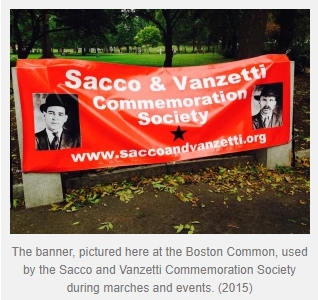 19/04/2020 - April 15th marks the 100th anniversary of the crime that propelled Italian immigrant anarchists Nicola Sacco and Bartolomeo Vanzetti into the international media spotlight: the robbery and double murder at the Slater & Morrill Shoe Company Factory in South Braintree, Massachusetts. Arguably the most famous criminals tried in the 20th century, in a trial that incited a flurry of debates over the manipulation and use of insufficient evidence, questionable testimony, and ethnic bias against defense witnesses, Sacco and Vanzetti were found guilty and spent seven years in jail until their execution on August 23, 1927. 19/04/2020 - April 15th marks the 100th anniversary of the crime that propelled Italian immigrant anarchists Nicola Sacco and Bartolomeo Vanzetti into the international media spotlight: the robbery and double murder at the Slater & Morrill Shoe Company Factory in South Braintree, Massachusetts. Arguably the most famous criminals tried in the 20th century, in a trial that incited a flurry of debates over the manipulation and use of insufficient evidence, questionable testimony, and ethnic bias against defense witnesses, Sacco and Vanzetti were found guilty and spent seven years in jail until their execution on August 23, 1927.
Read more
The crime that began the Sacco-Vanzetti case 19/04/2020 - It’s a tough time in America right now. No one’s disputing that. But it was a tough time a hundred years ago as well, especially for immigrants and civil liberties. 19/04/2020 - It’s a tough time in America right now. No one’s disputing that. But it was a tough time a hundred years ago as well, especially for immigrants and civil liberties.
Today, April 15, marks the 100th anniversary of the crime that began the notorious Sacco and Vanzetti case in which two Italian immigrants who professed anarchist beliefs were accused without a shred of real evidence of committing a heinous crime, tried in a prejudiced courtroom, convicted by a nativist jury, and ultimately executed seven years later, by which time their case had become an international cause de celebre.
Read more
Flowers in the Dark 27/08/2015 - by Susan Tejada, author of In Search of Sacco and Vanzetti. 27/08/2015 - by Susan Tejada, author of In Search of Sacco and Vanzetti.
“Officials from San Quentin in California to Rikers Island in New York have turned dusty patches into powerful metaphors for rebirth,” the Washington Post reports in a recent story on horticultural therapy. Inmate-garderners find purpose and a measure of inner peace, learning to grow something in dirt that will feed others or simply flourish in beauty.
Nicola Sacco and Bartolomeo Vanzetti, prisoners themselves nearly a century ago in Massachusetts, would have known this instinctively.
Read more
Kenneth Rexroth reading "Climbing Milestone Mountain, August 22, 1937."
To see the video and read the poem click on "read more" below.
Read more
Remarks By Honorable Peter W. Agnes, Jr. Acceptance of the Sacco and Vanzetti Memorial August 23, 1997.- Governor Cellucci, Mayor Menino, distinguished guests and friends. We are here today to recognize the achievement of an extraordinary American artist, Gutzon Borglum, to remember that it was a grave injustice visited upon two immigrant Italians who lived and worked in this Commonwealth that inspired him to create this magnificent work of art, and to celebrate the decision by an Italian-American mayor and an Italian-American August 23, 1997.- Governor Cellucci, Mayor Menino, distinguished guests and friends. We are here today to recognize the achievement of an extraordinary American artist, Gutzon Borglum, to remember that it was a grave injustice visited upon two immigrant Italians who lived and worked in this Commonwealth that inspired him to create this magnificent work of art, and to celebrate the decision by an Italian-American mayor and an Italian-American
governor to accept the Borglum Plaque.
Today is much more than a commemoration; much more than a photo opportunity. Today, a vision of something conceived "in the last hour of agony" suffered by Sacco and Vanzetti is being realized.
To read full text click here.
Remarks of Mayor Thomas M. Menino Acceptance of Sacco and Vanzetti Memorial August 23, 1997.- Thank you, Judge Agnes. Welcome, everyone, to this historic occasion. Governor Cellucci, thanks you for being here today. And I'd like to express my thanks to Judge Agnes and the Massachusetts Dante Alighieri Society for your efforts to bring about this event. August 23, 1997.- Thank you, Judge Agnes. Welcome, everyone, to this historic occasion. Governor Cellucci, thanks you for being here today. And I'd like to express my thanks to Judge Agnes and the Massachusetts Dante Alighieri Society for your efforts to bring about this event.
The Dante Alighieri Society does important work for the ltalian-American community, and it's thanks to events like this one that the Italian-American community in Boston remains active and thriving.
On behalf of the City of Boston, on the seventieth anniversary of the execution of Sacco and Vanzetti, I am pleased to accept this work of art.
To read the full text click here.
Justice Denied In Massachusetts - Short film adaptation in YouTube
In 1947 modern dancer Judy Job (1925-2026) composed and performed a dance to mark the 20th anniversary of the execution of Sacco and Vanzetti. Danced to the music of Ernest Bloch (here performed by Marian Conti, but in 1947 for Judy Job by the late pianist Naomi Sparrow) combined with a reading of Edna St Vincent Millay's poem, "Justice Denied in Massachusetts." With only two still photos from the 1947 performance surviving, this montage uses those two photos, as well as photos supplied by the Sacco and Vanzetti Commemoration Society.
Message from Chuck Turner to the 7th Sacco and Vanzetti Commemoration Day in Boston 26/08/2012 - USP Hazelton, WV .- Thank you and your committee for your work in using the state murder of Sacco and Vanzetti to remind us of our continuous responsibility to demand a governing and judicial process in this country built on a foundation of sanity and justice. The recent horrendous conviction of Tarek Mehanna for exercising his first amendments rights is a tragic reminder that the clouds of fascism and repression in this country are growing darker and more ominous every day. We must increase the brightness of our light and the volume of our demand in order to wake our fellow citizens from their deep an dangerous sleep. In the Spirit of Peace and Love, Chuck Turner. 26/08/2012 - USP Hazelton, WV .- Thank you and your committee for your work in using the state murder of Sacco and Vanzetti to remind us of our continuous responsibility to demand a governing and judicial process in this country built on a foundation of sanity and justice. The recent horrendous conviction of Tarek Mehanna for exercising his first amendments rights is a tragic reminder that the clouds of fascism and repression in this country are growing darker and more ominous every day. We must increase the brightness of our light and the volume of our demand in order to wake our fellow citizens from their deep an dangerous sleep. In the Spirit of Peace and Love, Chuck Turner.
Read more
Sacco and Vanzetti Yesterday and Today's Immigrants Dorotea Manuela, activist for workers rights, was unable to address the event on August 26, 2012. You can, however, read here the speach she had prepared for the occassion. Dorotea Manuela, activist for workers rights, was unable to address the event on August 26, 2012. You can, however, read here the speach she had prepared for the occassion.
"(...) How strangely reminiscent are today's events. Arabs, Latin@s, Haitians and Caribbeans are kidnapped from their streets and confined in secret prisons where they rot without hearing or trial. We do not even need the sham trials of Sacco and Vanzetti.
In addition, our xenophobes in Congress and the press announce that yesterday's Italians are today's Latino, Haitian and Caribbean immigrants. They come here, we are told, to draw our resources, to burden our schools, to overwhelm our services and to collect welfare. Paradoxically these "lazy immigrants" are taking all of our jobs."
Read more
Message from Chuck Turner from behind bars for the Sacco and Vanzetti Commemoration Day 2011 21/08/2011 - "I regret not being able to be with you physically; however, I am certainly with you in spirit. Let me begin my reflections by commending the organizers for continuing to keep the focus on the horrible tragedy that occurred when Nicola Sacco and Bartolomeo Vanzetti were executed for a crime they did not commit. Fortunately, the work of activists over decades finally resulted in Governor Dukakis acknowledging the truth and clearing their names. However, this important work does not eliminate the fact that their lives were taken by a criminal justice system seeking revenge rather than justice. 21/08/2011 - "I regret not being able to be with you physically; however, I am certainly with you in spirit. Let me begin my reflections by commending the organizers for continuing to keep the focus on the horrible tragedy that occurred when Nicola Sacco and Bartolomeo Vanzetti were executed for a crime they did not commit. Fortunately, the work of activists over decades finally resulted in Governor Dukakis acknowledging the truth and clearing their names. However, this important work does not eliminate the fact that their lives were taken by a criminal justice system seeking revenge rather than justice.
As we gather together today to acknowledge the tragic error of the government of that era in their unwillingness to seek justice, the question we must answer is what are we doing to stop the reoccurrence of such governmental injustice today, whether lives are being physically ended or destroyed through incarceration. What good does it do to call attention to the tragedy that occurred to Sacco and Vanzetti, if we do not organize to stop the present day governmental victimization of our brothers and sisters."
Read more
Socialist Perspective on Sacco and Vanzetti 21/08/2011 - Presentation by Kevin Dwire, Socialist Workers Party candidate for City Council At-Large, at the Sacco and Vanzetti Rally, August 21, 2011 21/08/2011 - Presentation by Kevin Dwire, Socialist Workers Party candidate for City Council At-Large, at the Sacco and Vanzetti Rally, August 21, 2011
We are here today not to mourn, but to honor Sacco and Vanzetti. The history of the struggles of working men and women here and around the world is one that the capitalist class hopes we will forget, and their hired hands work overtime to cover it up and "educate" us that their history is our history.
But it is not only the events of 1927 that brings us here today. It is the living class struggle of 2011 — the growing economic depression and the continuing war by the owners of capital to make working people pay for their crisis. It is a war being waged in factory and field, a campaign against working people wherever we toil, to drive down our wages and so called benefits, to take away those few extra crumbs we have been able to wrestle from them over the years. It is a war on our democratic rights as they field an army of cops and snoops against our class, our unions, and our political organizations.
Read more
Yesterday Sacco and Vanzetti; now Tarek Mehanna30/08/2010 - Speech by Laila Murad from the Tarek Mehanna Defense Committee at the Sacco Vanzetti Memorial 2010
Today many of us have been reminded of the case of Sacco and Vanzetti. Theirs is a case that has been referred to as "the case that never goes away" and it is indeed a case that we saw in the years before it even began and one that we have seen countless times in the 83 years since.
Over the decades we have seen the FBI's COINTELPRO attack on communities to crush movements of struggle and dissent such as the Black Panther Party, Black Liberation Army, Puertro Rican Independence Movement, American Indian Movement and Earth Liberation Movement.
Over the past 10 or so years, we have seen the War on Terror targeted primarily Muslims and people of Arab and South Asian decent, as well anarchists and radical environmentalists.
Read more
How to honor victims of political violence30/08/2010 - Commemoration of Sacco and Vanzetti Speech by Pasqualino Colombaro
It was a very fortunate intuition six years ago to form a Committee for the commemoration of Sacco and Vanzetti. Because the very image that the story of the two Anarchists evokes, is replete with valuable teachings and meanings for all those who today dare to struggle for a free and egalitarian way of life for all.
Nicola Sacco and Bartolomeo Vanzetti were two ordinary human beings, two workers, two immigrants from Italy like millions of others. With one difference: they had the spark of critical consciousness awoken within their hearts. They were self-professed Anarchist labor and community activists who had the misfortune to gravitate around a Massachusetts Italian Anarchist enclave headed by Luigi Galleani, an Italian Anarchist intellectual who passionately and convincingly advocated for the propaganda of the deed, i.e.: targeted violent action against the system of oppression, which included bomb throwing and assassinations. Read more
Chuck Turner's speech at the Sacco and Vanzetti Commemoration Day 2010 Brothers and Sisters, the immigrants in this country aren't the enemy. The reality is, from my perspective, immigrants are the victims. Why are the immigrants here? The immigrants are here in this day and age, the immigrants are coming into this country, because our country, our military forces are enabling the business community of this country - of this country and other countries - to go throughout the world raping and pillaging the economies of those countries. We have to understand that the immigrant "problem" is not an immigrant problem. It is a problem of imperialism. It's a problem of the unjust use of force to control the economies of other countries. Brothers and Sisters, the immigrants in this country aren't the enemy. The reality is, from my perspective, immigrants are the victims. Why are the immigrants here? The immigrants are here in this day and age, the immigrants are coming into this country, because our country, our military forces are enabling the business community of this country - of this country and other countries - to go throughout the world raping and pillaging the economies of those countries. We have to understand that the immigrant "problem" is not an immigrant problem. It is a problem of imperialism. It's a problem of the unjust use of force to control the economies of other countries.
Read more
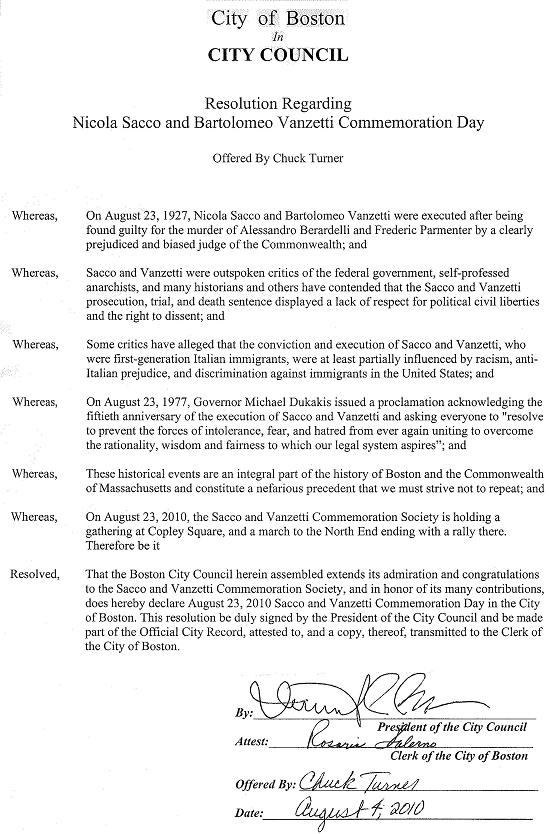
2010 Boston City Council Resolution Regarding Nicola Sacco and Bartolomeo Vanzetti Commemoration DayThis resolution offered by Boston City Councilor Chuck Turner on August 4, 2010 read partially:
"Whereas, These historical events are an integral part of the history of Boston and the Commonwealth of Massachusetts and constitute a nefarious precedent that we must strive not to repeat; and
Whereas, On August 23, 2010, the Sacco and Vanzetti Commemoration Society is holding a gathering at Copley Square, and a march to the North End ending with a rally there. Therefore be it
Resolved, That the Boston City Council herein assembled extends its admiration and congratulations to the Sacco and Vanzetti Commemoration Society, and in honor of its many contributions does hereby declare August 23, 2010 Sacco and Vanzetti Commemoration Day in the City of Boston."
To see a picture of the actual resolution click here. Read more
Howard Zinn: Anarchism Shouldn't Be a Dirty Word08/02/2010 - An interview with Ziga Vodovnik, CounterPunch, May 2008.
Howard Zinn: "I am an anarchist, and according to anarchist principles nation states become obstacles to a true humanistic globalization. In a certain sense the movement towards globalization where capitalists are trying to leap over nation state barriers, creates a kind of opportunity for movement to ignore national barriers, and to bring people together globally, across national lines in opposition to globalization of capital, to create globalization of people, opposed to traditional notion of globalization. In other words to use globalization -- it is nothing wrong with idea of globalization -- in a way that bypasses national boundaries and of course that there is not involved corporate control of the economic decisions that are made about people all over the world."
Read more
Saying goodbye to my friend Howard Zinn 31/01/2010 - By Alice Walker, Globe Correspondent 31/01/2010 - By Alice Walker, Globe Correspondent
On hearing the news of his death.
Me: Howie, where did you go?
Howie: What do you mean, where did I go? As soon as I died, I went back to Boston.
I met Howard Zinn in 1961, my first year at Spelman College in Atlanta. He was the tall, rangy, good-looking professor that many of the girls at Spelman swooned over. My African roommate and I got a good look at him every day when he came for his mail in the post office just beneath our dormitory window. He was always in motion, but would stop frequently to talk to the many students and administrators and total strangers that seemed attracted to his energy of non-hesitation to engage. ...
Read more
Sacco and Vanzetti - Martyrdom of Workers Speech by Dorothea Manuela from the Boston May Day Committee at the Sacco and Vanzetti Commemoration Rally in the North End, Boston. August 23, 2009 Speech by Dorothea Manuela from the Boston May Day Committee at the Sacco and Vanzetti Commemoration Rally in the North End, Boston. August 23, 2009
Today we commemorate the execution of Sacco and Vanzetti, two immigrant working men whose lives were taken by the state because they were radicals and foreigners. Sacco and Vanzetti are part of a long list of working class martyrs who died in the struggle against corporate greed and for workers rights. That struggle in various forms continues today, and we are animated by the spirit of Sacco and Vanzetti and must dedicate ourselves to a continuation of that struggle.
Read more
Memorializing Sacco and Vanzetti in Boston "WHO WERE THOSE PEOPLE?" historian Howard Zinn asked a member of the Sacco and Vanzetti Commemoration Society in November 2008. Zinn had just delivered a lecture for the benefit of the Society on "The Meaning of Sacco and Vanzetti" to a crowd of at least 250 people overflowing the Dante Alighieri Italian Cultural Center in Cambridge, Massachusetts, and was taken aback that interest in the case was still alive. "I didn't know what to expect. I thought, how many people are still interested in Sacco and Vanzetti? Maybe seven? Ten? Fifteen? I can't even [tell?] but this place is full!" Accustomed to smaller crowds composed of all the same familiar radical characters of Greater Boston, I, myself, was surprised at the size of the diverse and intergenerational crowd. "WHO WERE THOSE PEOPLE?" historian Howard Zinn asked a member of the Sacco and Vanzetti Commemoration Society in November 2008. Zinn had just delivered a lecture for the benefit of the Society on "The Meaning of Sacco and Vanzetti" to a crowd of at least 250 people overflowing the Dante Alighieri Italian Cultural Center in Cambridge, Massachusetts, and was taken aback that interest in the case was still alive. "I didn't know what to expect. I thought, how many people are still interested in Sacco and Vanzetti? Maybe seven? Ten? Fifteen? I can't even [tell?] but this place is full!" Accustomed to smaller crowds composed of all the same familiar radical characters of Greater Boston, I, myself, was surprised at the size of the diverse and intergenerational crowd.
To read the full paper in pdf format click here.
Read more
Nicola Sacco and Bartolomeo Vanzetti, a painting by Paul Normandia Sacco and Vanzetti were Italian immigrants and anarchists. They were accused of the murder of a shoe factory paymaster and guard and were convicted in 1921 in an atmosphere of antiradical an racist hysteria. In 1927 they were executed in Boston despite widespread belief in their innocence and a huge movement protesting the sentence. Sacco and Vanzetti were Italian immigrants and anarchists. They were accused of the murder of a shoe factory paymaster and guard and were convicted in 1921 in an atmosphere of antiradical an racist hysteria. In 1927 they were executed in Boston despite widespread belief in their innocence and a huge movement protesting the sentence.
"Never in our full lives could we hope to do such work for tolerance, for justice, for man's understanding of men as now we do by accident... That last moment belongs to us. That agony is our triumph." -- Bartolomeo Vanzetti
Original 60x48 inches painting by Paul Normandia for a May First 1999 event organized by Spontaneous Celebrations in Jamaica Plain, Massachusetts.
Read more
How does a child understand? -- Speech by Robert Meeropolon August 23rd, Massachusetts Citizens Against the Death Penalty (MCADP) held a ceremony in Boston's North End commemorating the 80th anniversary of the executions of Nicola Sacco and Bartolomeo Vanzetti. Speakers included former Governor Michael Dukakis, Representative Michael Festa, MVFHR's Robert Meeropol and Renny Cushing, and David Ehrmann, whose grandfather, Herbert Ehrmann, served as a junior counsel for the defense during the last two years of the Sacco and Vanzetti case. David is now the president of MCADP, which was founded shortly after Sacco and Vanzetti's executions. Although Massachusetts does not currently have the death penalty, MCADP says that "Sacco and Vanzetti continue to symbolize the inherent defect in the death penalty. Sacco and Vanzetti endure as a reminder that the death penalty is always about politics rather than justice."
In his remarks during the ceremony, Robert Meeropol drew another connection between Sacco and Vanzetti's executions and the present day. ...
Read more
[PAST] 5 minutes on Sacco & Vanzetti24/08/2007 - (Text of the speech delivered by Pasqualino Colombaro on 8/23/07 at the memorial rally held at the Langone Park in the North End of Boston.)
The North End is where we can still hear the echoes of their steps and where for 7 years the mobilization in their defense was headquartered. A veritable global network of support and solidarity sprang out of here to block their execution and for their freedom. Hard to imagine it today surrounded as we are by a myriad mediocre Italian restaurants...
Read more
[PAST] Sacco and Vanzetti: 80 years have passed and new targets of repression have been chosen24/08/2007 - (Speech delivered by Jennifer Dowdell on behalf of Dorotea Manuela of the Boston May Day Coalition who couldn't attend the rally of 8/23/07 due to illness) ... A reporter for the Boston Transcript commented, "theres no story ... just a couple of wops in a jam"! Some jurors, during the trial, openly expressed hostility toward the defendants.
In spite of worldwide protest at the unfairness of the trial, these men were put to death.
How strangely reminiscent are today's events. Arabs are kidnapped from the streets of Berlin and confined in secret prisons or are shipped to Guantanamo where they rot without hearing or trial. We do not even need the sham trials of Sacco and Vanzetti.
Read more
[PAST] Italy's American Baggage
23/08/2007 - Op-Ed by ANDREA CAMILLERI, Published by the New York Times, August 23, 2007.
THE century we left behind us just seven years ago was brilliantly described by the British historian Eric Hobsbawm as "the short century." But perhaps a more exact definition would be "the compressed century," for never has a period of 100 years seen so many world wars, so many scientific and technological advances, so many revolutions, so many epoch-making events piled almost one on top of the other. Indeed, the past century seems rather like a suitcase too small to hold everything that happened: it's too crammed with used clothing, some of which hinders us from closing it and putting it away in the attic once and for all.
To read the full article click here. Read more
2007: City of Boston passes 1st. resolution in commemoration of Sacco & Vanzetti At the initiative of Boston City Councillor Felix Arroyo, and co-sponsored by Stephen Murphy and Chuck Turner, the Boston City Council passed a resolution declaring "that the Boston City Council does hereby extend its admiration and congratulations to the Sacco and Vanzetti Commemoration Society, and in honor of its many contributions, does hereby declare August 23, 2007, Sacco and Vanzetti Commemoration Day in the City of Boston". The original, sealed document was presented to the Society during the rally at the Langone Park in the North End of Boston by Councillor Arroyo. At the initiative of Boston City Councillor Felix Arroyo, and co-sponsored by Stephen Murphy and Chuck Turner, the Boston City Council passed a resolution declaring "that the Boston City Council does hereby extend its admiration and congratulations to the Sacco and Vanzetti Commemoration Society, and in honor of its many contributions, does hereby declare August 23, 2007, Sacco and Vanzetti Commemoration Day in the City of Boston". The original, sealed document was presented to the Society during the rally at the Langone Park in the North End of Boston by Councillor Arroyo.
Read more
Reasons of State
A Memorial to Sacco and Vanzetti Erich Mühsam wrote Reasons of State: A Memorial to Sacco and Vanzetti on the first anniversary of their execution. CR Edmonston has sent us his recent English translation of the play and we are happy to have the opportunity to make it available to you. Erich Mühsam wrote Reasons of State: A Memorial to Sacco and Vanzetti on the first anniversary of their execution. CR Edmonston has sent us his recent English translation of the play and we are happy to have the opportunity to make it available to you.
Erich Mühsam (6 April 1878 in Berlin, Germany - 10 July 1934 Oranienburg Concentration Camp) (also spelled Muehsam or Muhsam) was a German-Jewish anarchist, writer, poet, dramatist and cabaret performer.
Both a prolific poet, dramatist and a Bohemian intellectual, Mühsam emerged at the end of World War I as one of the leading agitators for a federated Bavarian Soviet Republic. However, Mühsam achieved international prominence during the years of the Weimar Republic (1919-1933) for works which satirized Adolf Hitler and condemned Nazism before Hitler came to power in 1933. (Wikipedia).
To read the full play in pdf format please click here.
Read more
The Passion of Sacco and Vanzettiby Joseph E. Mulligan
August 23, 2007 will mark the 80th anniversary of the execution of Sacco and Vanzetti. Their story has been told in books, articles, and songs, but perhaps never so engagingly as in the historical novel, THE PASSION OF SACCO AND VANZETTI: A NEW ENGLAND LEGEND, by Howard Fast (New York: Blue Heron Press, 1953).
Read more
Comunicato stampa
Sacco e Vanzetti vivono!A fine agosto verra' commemorato a Boston l'ottantesimo anniversario dell'esecuzione di Nicola Sacco e Bartolomeo Vanzetti. La loro condanna a morte nel 1927 e' passata alla storia come una delle piu' obbrobriose farse giudiziarie mai commesse da una corte di un paese democratico. Dagli atti del processo emerge infatti molto mal celato il pregiudizio della corte contro gli immigrati italiani e in particolar modo contro quegli immigrati che erano animati da chiari convincimenti politici di tipo anarchico. Read more
Boston, 2007: Sacco y Vanzetti viven08/08/2007 - Read more
Press Release
Sacco and Vanzetti Live!To see the press release about the activities in commemoration of the 80th anniversary of the execution of Sacco and Vanzetti please click on the title of this note. Thank you. Read more
Sacco and Vanzetti on YouTube There is a selection of independent videos posted on YouTube in memory of Sacco and Vanzetti in different languages. The fact that people around the world still remembers the injustice of the so-called judicial murder of the two anarchists is evidence that they didn't die in vain. There is a selection of independent videos posted on YouTube in memory of Sacco and Vanzetti in different languages. The fact that people around the world still remembers the injustice of the so-called judicial murder of the two anarchists is evidence that they didn't die in vain.
To go to Sacco and Vanzetti on YouTube click here.
Community Church of Boston Sacco-Vanzetti Memorial and Award Since 1976The Community Church of Boston is proud to have one of three existing castings of the Sacco-Vanzetti memorial bas relief by noted sculptor Gutzon Borglum, creator of the Mount Rushmore presidential sculpture in South Dakota. The sculpture is on display in Lothrop Auditorium on the second floor of the Community Church Center at 565 Boylston Street in Copley Square, Boston. To read the story behind this sculpture written by Carol Adams and Rev. David Carl Olson click on the title of this article. Read more
Memorial site eyed for Sacco, Vanzetti Boston Globe, January 17, 1999 Boston Globe, January 17, 1999
North End. A small patch of land in DeFillipo Park on Hull Street likely will be the site of a memorial to Sacco and Vanzetti, Italian immigrants executed in 1927 for the murder of a paymaster and guard during a robbery in Braintree in 1920.
Members of the Sacco and Vanzetti Memorial Committee met recently with Parks Commissioner Justine Liff, who told them she had no objections to a memorial in the city-owned park that includes basketball and handball courts and a playground. The next step for the committee, said parks department spokeswoman Mary Hines, is to submit a written proposal, or concept paper, to the Parks Commission which has final approval.
Read more
The Monument to Sacco and Vanzetti that Never Saw the Streets of Boston Boston, July 15, 2007. In 1997 (exactly August 23) a 10-years younger Thomas Menino received as Mayor of Boston a relief of Sacco and Vanzetti sculpted by the famous author of the Mt. Rushmore National Memorial depicting the first 150 years of independent history of the U.S. with the likeness of Washington, Jefferson, Roosevelt and Lincoln. The artist's name was (John) Gutzon de la Mothe Borglum. The massive project in Mt. Rushmore sharply contrasts with the 7-foot size of the Sacco and Vanzetti relief that reads: Boston, July 15, 2007. In 1997 (exactly August 23) a 10-years younger Thomas Menino received as Mayor of Boston a relief of Sacco and Vanzetti sculpted by the famous author of the Mt. Rushmore National Memorial depicting the first 150 years of independent history of the U.S. with the likeness of Washington, Jefferson, Roosevelt and Lincoln. The artist's name was (John) Gutzon de la Mothe Borglum. The massive project in Mt. Rushmore sharply contrasts with the 7-foot size of the Sacco and Vanzetti relief that reads:
"What I wish more than all in this last hour of agony is that our case and our fate may be understood in their real being and serve as a tremendous lesson to the forces of freedom, that our suffering and death will not have been in vain."
What happened to that monument?
Read more
La Salute é in Voi: the Anarchist DimensionBy Robert D'Attilio
William G. Thompson, the chief counsel for Sacco and Vanzetti during the final three years of their legal struggle, has told us in a very moving memoir that he had been asked by Vanzetti to come to Charlestown Prison just hours before their execution. Vanzetti had come to respect the integrity and the tremendous efforts that Thompson-a Brahmin, a conservative, a lawyer -had made against the legal system he believed in and upheld, to defend two anarchists who had been trying to bring that very system down. Before dying, Vanzetti wanted to thank Thompson for his efforts and to assure him that, though they had not succeeded, they were deeply appreciated. In the course of his remarks Vanzetti strongly reasserted the absolute innocence of Sacco and himself in the Braintree affair, and he also told Thompson that ... he now realized more clearly than ever the grounds of suspicion against him and Sacco ... but that no allowance had been made for his fear as a radical and almost as an outlaw and that in reality he was convicted on evidence which would not have convicted him had he not been an anarchist, so that he was in a very real sense dying for his cause. He said that it was a cause for which he was prepared to die. Read more
Proclamation by Gov. Michael S. Dukakis of Nicola Sacco and Bartolomeo Vanzetti Memorial Day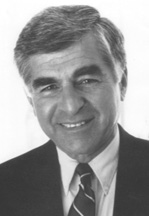 Therefore, I, Michael S. Dukakis, Governor of the Commonwealth of Massachusetts Therefore, I, Michael S. Dukakis, Governor of the Commonwealth of Massachusetts
hereby proclaim Tuesday, August 23, 1977, "NICOLA SACCO AND BARTOLOMEO VANZETTI MEMORIAL DAY";
and declare, further, that any stigma and disgrace should be forever removed from the names of Nicola Sacco and Bartolomeo Vanzetti, from the names of their families and descendants, and so
call upon all the people of Massachusetts to pause in their daily endeavors to reflect upon these tragic events, and draw from their historic lessons the resolve to prevent the forces of intolerance, fear, and hatred from ever again uniting to overcome the rationality, wisdom, and fairness to which our legal system aspires.
Read more
Boston accepts Sacco and Vanzetti memorial (1997) Others, too, felt a sense of closure in the rare book room at Boston Public Library on Saturday when the city's Italian-American mayor and the state's Italian-American acting governor removed a red cloth from the seven-foot sculpture. Others, too, felt a sense of closure in the rare book room at Boston Public Library on Saturday when the city's Italian-American mayor and the state's Italian-American acting governor removed a red cloth from the seven-foot sculpture.
With that gesture, acting Gov. Paul Cellucci and Mayor Tom Menino (see photo) formally accepted the piece. Menino talked about fairness and about learning, and Cellucci talked about tolerance.
Read more
Sacco and Vanzetti by Howard Zinn Fifty years after the executions of Italian immigrants Sacco and Vanzetti, Governor Dukakis of Massachusetts set up a panel to judge the fairness of the trial, and the conclusion was that the two men had not received a fair trial. This aroused a minor storm in Boston. Fifty years after the executions of Italian immigrants Sacco and Vanzetti, Governor Dukakis of Massachusetts set up a panel to judge the fairness of the trial, and the conclusion was that the two men had not received a fair trial. This aroused a minor storm in Boston.
One letter, signed John M. Cabot, U.S. Ambassador Retired, declared his "great indignation" and pointed out that Governor Fuller's affirmation of the death sentence was made after a special review by "three of Massachusetts' most distinguished and respected citizens -- President Lowell of Harvard, President Stratton of MIT and retired Judge Grant."
The Mexican newspaper La Jornada printed an Spanish translation of this article on August 23, 2007. On the same article they announced that Howard Zinn's book, "A Power Government Cannot Suppress" will be published in Spanish in Mexico by La Jornada in the near future.
Para ver la traduccion de este articulo publicado por La Jornada pinchar aqui.
Read more
|